Why automatic translations are damaging your SEO and your business on the Costa Blanca
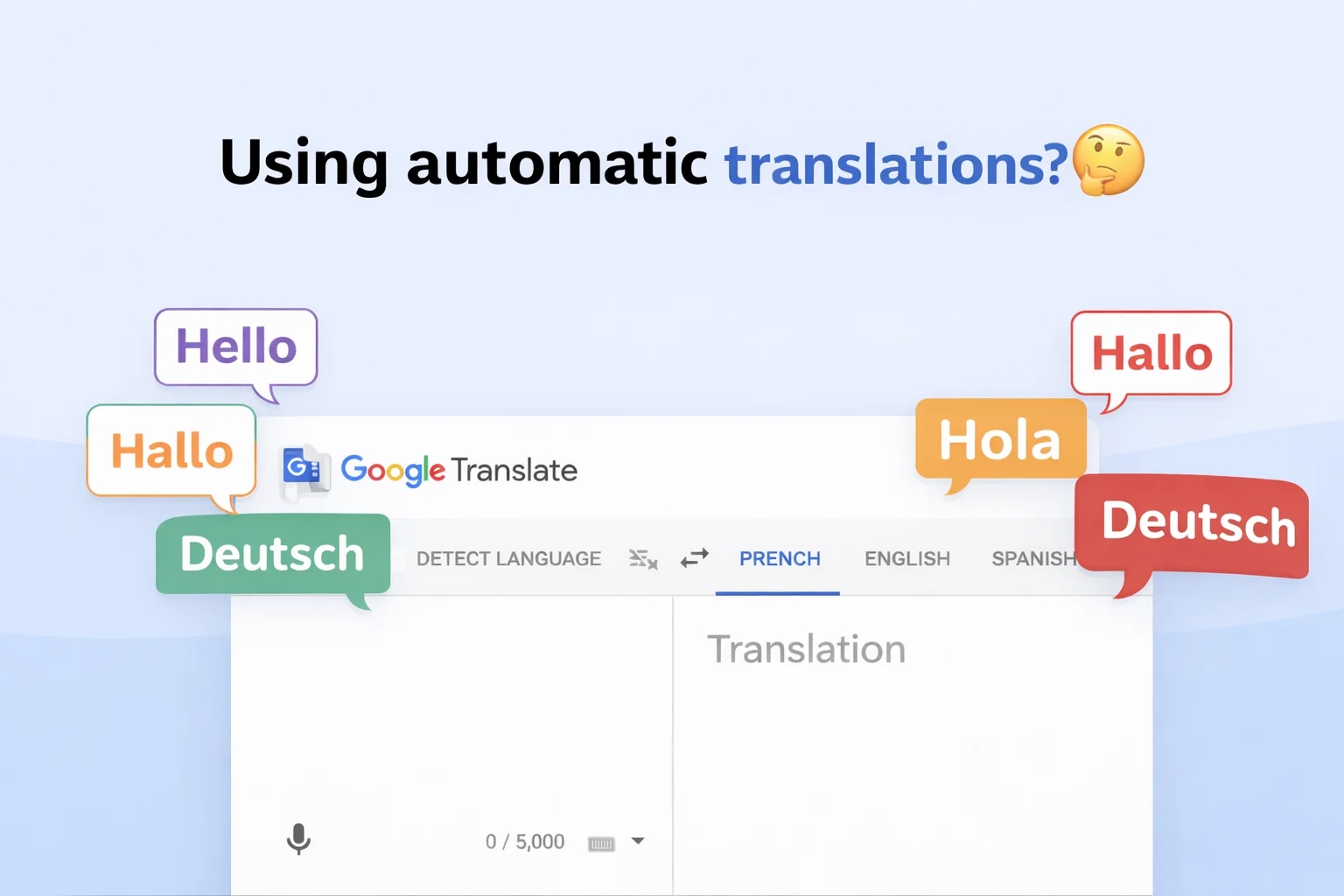

A translation button looks like a quick fix for reaching international clients. For your SEO, it's closer to a self-inflicted wound. Here's what's actually happening under the hood.
Why automatic translations are damaging your SEO and your business on the Costa Blanca
Everyone wants multilingual fast. One plugin, one button, and suddenly the website is available in Dutch, English, German, and French. Done.
Except it isn't. Not for Google. And increasingly, not for the clients who land on those translated pages either.
What Google actually does with auto-translated content
Google's approach to automatically translated content is clearly documented in their Search Quality Guidelines: content translated automatically without human review is classified as low quality. It often gets filtered out of search results entirely, or ranks so far down it might as well not exist.
The reason is straightforward. Automatic translation tools produce text that is technically in another language but frequently loses meaning, mistranslates context, and produces phrasing that reads as unnatural to a native speaker. Google's systems can identify this. They've been trained to recognise the specific patterns that machine-translated text produces.
So that Dutch version of your website? Unless it was written or thoroughly reviewed by someone who actually writes Dutch, Google is likely treating it as low-quality content, not as a real Dutch page worth showing to Dutch searchers.
The duplicate content problem
Even when auto-translated content manages to avoid the quality filter, it creates a different problem: duplicate content.
Your Spanish, English, Dutch, and German pages are, in essence, the same content in different languages. Without proper technical setup (separate URL structures and hreflang tags), Google can't clearly distinguish between them. It may arbitrarily pick one version to rank and suppress the others, or it may penalise all versions for the perceived duplication.
The result is a website that tries to rank in 4 languages and ends up ranking well in none.
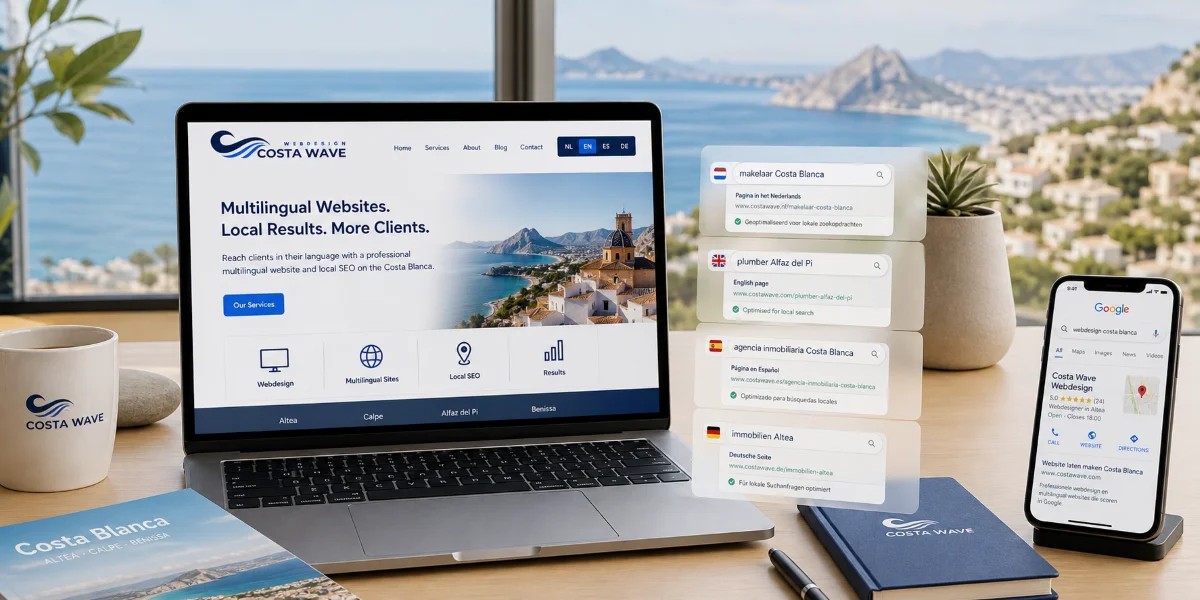
A properly built multilingual site uses separate URL paths for each language (/en/, /nl/, /es/), hreflang tags that tell Google which version to show to which audience, and real, independently written content per language. Each version gets indexed separately and builds its own ranking authority.
What it does to conversion
Beyond the SEO problem, there's a more immediate one: auto-translated text reads like auto-translated text.
Dutch clients landing on a Dutch page can tell within 2 sentences whether it was written by a human or generated by a tool. The vocabulary is slightly off. The sentence structure doesn't quite sound like someone actually wrote it. The legal or property terminology gets garbled in ways that, if you're considering a €300,000 purchase, make you want to call someone else.
On the Costa Blanca, where trust is the primary factor in a client's decision to work with you rather than the agency down the road, this matters enormously. A Dutch page that reads poorly doesn't just fail to attract Dutch clients. It actively pushes them toward whoever has a better one.
What proper multilingual actually requires
Real multilingual content means real content. Written for that audience, in their language, by someone who understands how they search and what they need to hear.
It doesn't have to be expensive or complicated to manage. A properly built CMS like Sanity makes it possible to maintain English, Dutch, and Spanish versions of every page without technical knowledge. The pages look different to each language's visitors, they rank differently in each language's search results, and they build trust differently with each audience.
The upfront investment is higher than a translation plugin. The return is a website that actually works in each language rather than appearing to.
Quick answers
Does Google penalise automatic translations? Google classifies automatically translated content without human review as low quality. It typically doesn't rank well and may be filtered from results entirely.
Does my website need separate URLs for each language? Yes. A translation overlay (like a Google Translate button) doesn't create real pages that Google can index. You need separate URL structures like /en/ and /nl/ for proper multilingual SEO.
How many languages does a Costa Blanca business website actually need? For most businesses, 3: Spanish, English, and Dutch. These cover the majority of the active market. More detail on choosing the right languages here.
What's wrong with a language button? A language button translates the page in the browser. Google can't see the result, can't index it, and can't rank it. Read the full explanation here.
If you want to know whether your current multilingual setup is actually working, send me your URL on WhatsApp and I'll tell you what Google sees.
Read more: