How many languages does your real estate website need?


More languages sounds like more reach. In practice, it's often the opposite. Here's how to choose the right languages for your real estate website on the Costa Blanca, and why 3 done well beats 8 done poorly.
How many languages does your real estate website need?
Look at real estate agency websites on the Costa Blanca and you'll often see a row of flags across the top. Spanish, English, Dutch, German, French, Russian, Swedish. Sometimes more.
The logic makes sense: the more languages you offer, the more clients you reach. In practice, it often works the other way.
More languages can mean a worse website
Adding a language means adding content. Real content, written for that audience, reviewed for accuracy, maintained over time. That's the version of multilingual that works.
What most agencies actually do is run everything through Google Translate or a cheap translation service and call it done. The result is text that technically reads in another language but loses meaning in the process. Terminology gets mistranslated. Local legal concepts get garbled. Phrases that sound professional in Spanish read as awkward or confusing in Dutch.
Buyers notice. Maybe they can't identify exactly what's wrong, but something feels off. And when you're asking someone to trust you with a €400,000 purchase, "something feels off" costs you the client.
Research by CSA Research found that 65% of consumers prefer content in their own language and 40% won't buy at all from sites available only in other languages. But that effect works in reverse too: a poor translation actively signals that the business hasn't invested in understanding its audience.
Duplicate content and SEO
Automatic translations create another problem: duplicate content.
If you take your English pages, run them through a translation tool, and publish the result as separate Dutch or German pages, Google sees near-identical content across multiple URLs. That's a duplicate content issue. It can suppress your rankings across all language versions rather than strengthening each one.
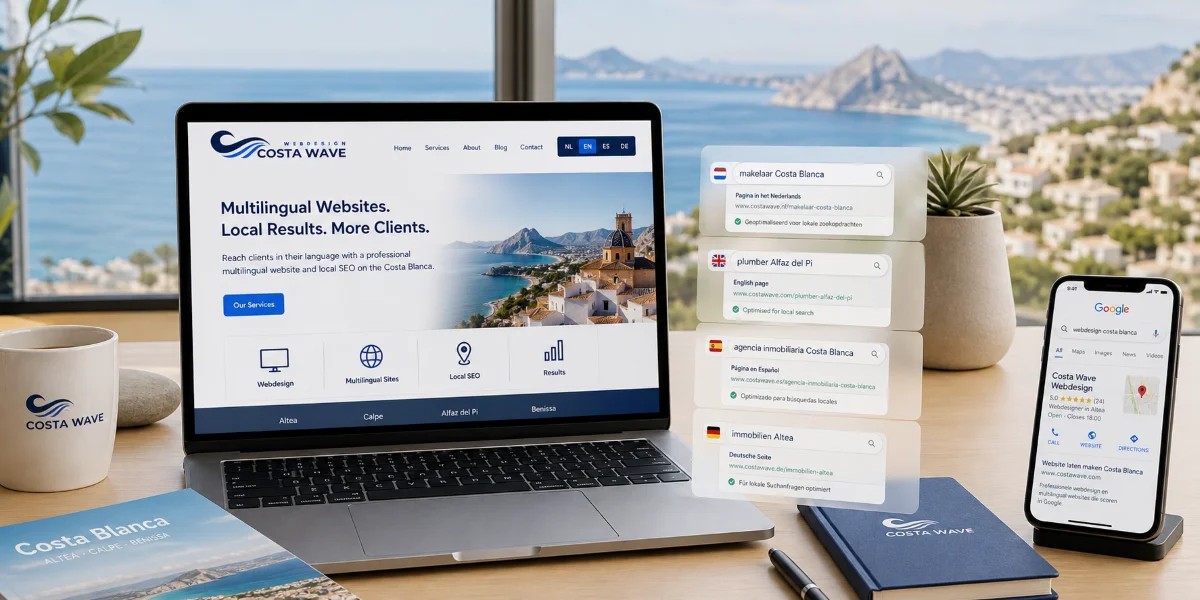
Properly built multilingual sites use separate URL structures per language (/en/, /nl/, /de/) with real, independently written content for each. Each version is indexed separately and ranks in its own language's search results.
Maintenance is real work
Every time a listing changes, every time your services change, every time you add a blog post: that update needs to happen in every language you support. The more languages, the more work. The more work, the more likely something gets missed and a language version becomes outdated.
An outdated language version is almost worse than no version at all. A buyer who finds a Dutch page with old information now doesn't trust the English version either.
So how many languages?
The right number is the number you can maintain properly.
For most real estate agencies on the Costa Blanca, that's 3: English, Dutch, and Spanish. These 3 cover the majority of the active buyer market. English reaches British, Irish, and international clients. Dutch reaches the large and consistently active Dutch and Belgian buyer market. Spanish covers local Spanish clients and searches.
German is worth considering if you actively work with German-speaking clients. French covers Belgian French-speakers and some Swiss buyers. Beyond that, the volume rarely justifies the maintenance cost unless you have dedicated staff or a system that handles it properly.
The question to ask: do you have the capacity to keep 4, 5, or 6 language versions genuinely up to date and well-written? If the honest answer is no, 3 languages done well will outperform 6 languages done poorly every time.
What proper multilingual looks like technically
A translation button or plugin is not a multilingual website. It looks multilingual to visitors but Google can't index it, which means it won't help you rank in Dutch or German search results.
Proper multilingual means separate URL paths, hreflang tags, and real content per language. It's the difference between showing up when a Dutch buyer searches "makelaar Costa Blanca" and being invisible to that search entirely.
The sites I build use this structure by default. The Professional package covers 3 languages, fully managed through the CMS with no technical knowledge needed.
If you want to know whether your current setup is actually working for multilingual SEO, send me your URL on WhatsApp and I'll tell you what I find.
Read more: