How to write content that works for SEO and AI search

SEO and AI search sound like separate problems. They're not. The same content that ranks well in Google is the content that gets cited in AI summaries. Here's how to write it.
How to write content that works for SEO and AI search
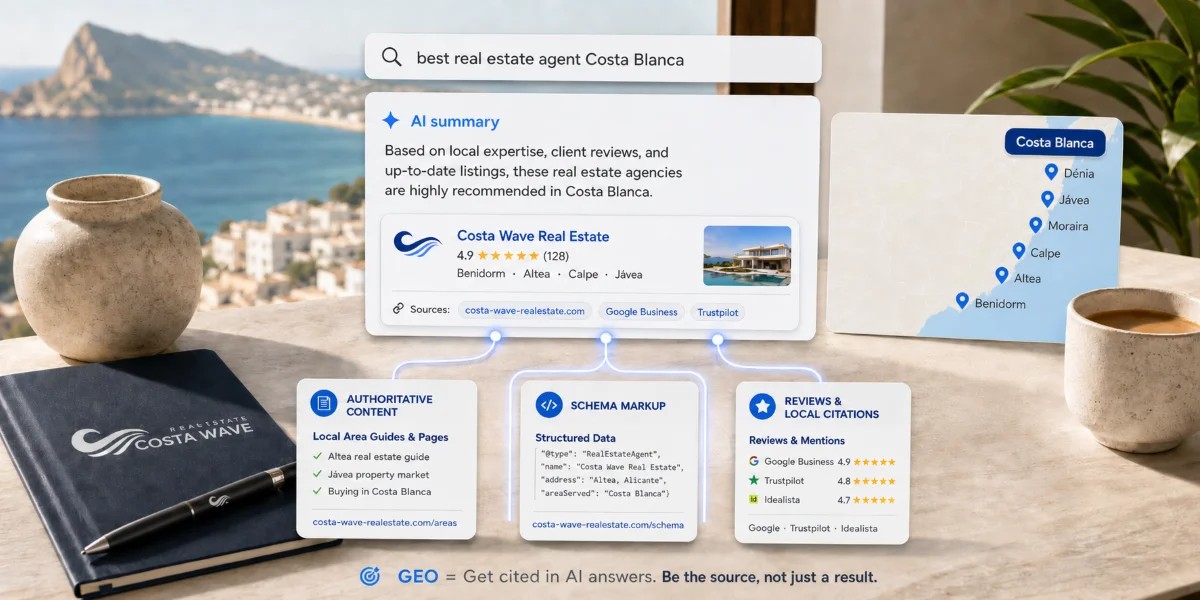
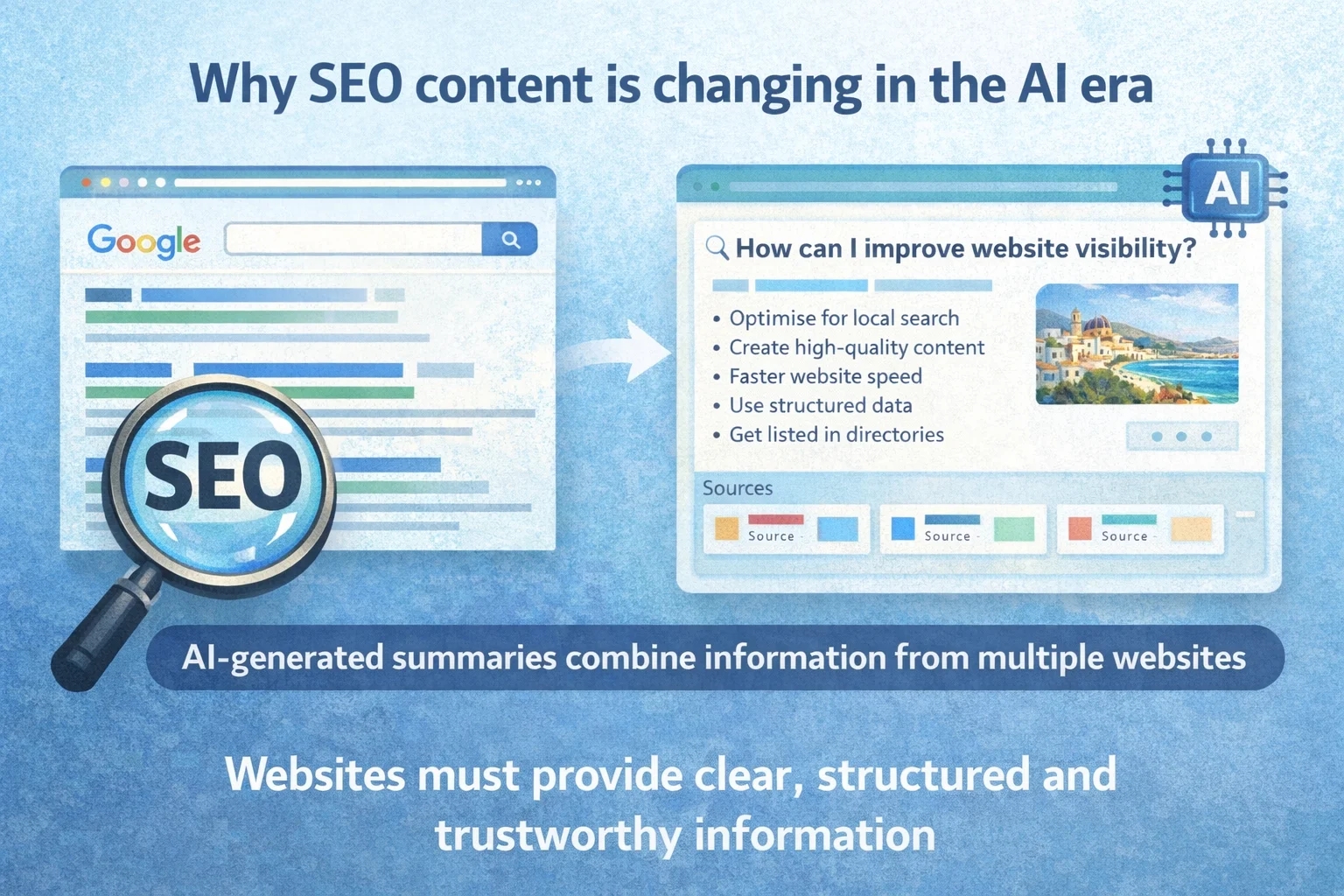
Search has changed. Type a question into Google and the first thing you might see isn't a list of links. It's a paragraph. Generated by AI, pulled from sources Google considers authoritative.
But here's the thing: those AI summaries pull from exactly the same sources that rank well in traditional search. The sites that appear at the top of Google are the sites getting cited in AI answers. The road is the same. There are just more destinations now.
So the question isn't "how do I write for AI search." The question is "how do I write content that actually deserves to rank," because that's what gets you everywhere.
Start with what the reader is actually trying to do
Every search has an intent behind it. Someone searching "plumber Altea" wants to call someone today. Someone searching "what does a plumber cost in Spain" is in research mode. Someone searching "plumber vs heating engineer" is trying to understand the difference before they decide.
Same broad topic. Three completely different needs.
Content that directly matches what the reader is trying to do performs better in search, gets read more, and gets cited more. Before writing anything, ask: what does this person actually want? What problem are they trying to solve? What decision are they trying to make?
Then answer that. Directly. At the start of the article, not buried in paragraph 4.
Structure matters more than you think
Search engines, and AI systems, parse content by looking for logical sections, clear headings, and well-organised paragraphs. A wall of text gives them nothing to grab onto. A clearly structured article with specific H2 headers, short focused paragraphs, and a logical flow from question to answer is far easier to index and cite.
Google recommends creating content that's helpful to people first, and the structure should reflect that. Write for the reader. The structure is just how you organise the thinking.
A practical check: read only the H2 headers of your page. Do they tell the story of the article? If someone scanned just the headings, would they understand what the page covers and what they'd learn by reading it? If not, the structure needs work.
E-E-A-T: what it is and why it matters here
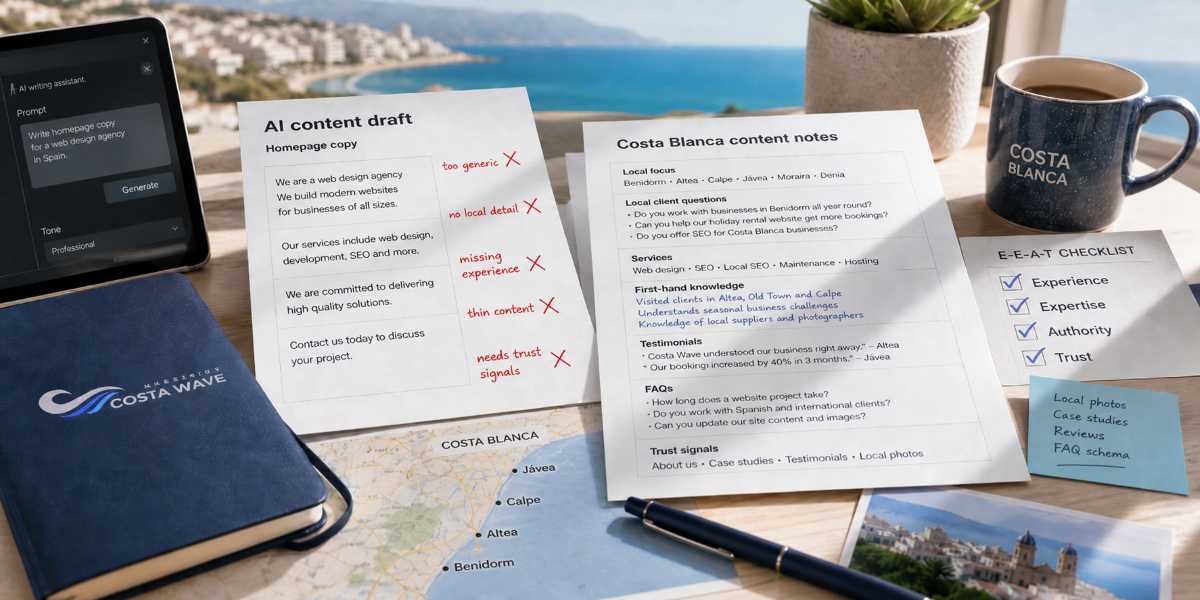
Google evaluates content using a framework called E-E-A-T: Experience, Expertise, Authoritativeness, Trustworthiness.
In practice, this means: does this content come from someone who actually knows what they're talking about, based on real experience? And can Google trust that the information is accurate?
For businesses on the Costa Blanca, this is both a challenge and an advantage. A lawyer who has handled hundreds of Spanish property purchases knows things about that process that a generalist article can't. A web designer who has built sites for local businesses on the Costa Blanca for years has specific, verifiable knowledge about this market.
Write from that knowledge. Mention specific cases where you can (without identifying clients). Name the places you work. Reference the specific problems you've solved. That specificity is what separates E-E-A-T content from generic content, and generic content is what AI systems skip.
Think in topics, not just individual articles
One well-optimised article is good. Ten articles that cover a topic from every angle are better.
Search engines start to recognise a site as an authoritative source on a subject when that site consistently publishes clear, connected content around that topic. This is called topical authority. The more thoroughly you cover a subject, the more signal Google has that your site is the right place to send people with questions about it.
On this site, the SEO cluster works this way: this article, the SEO terminology guide, and the local SEO guide for the Costa Blanca all cover different aspects of the same topic. Each one is useful on its own. Together they build authority.
Internal links are doing more than you think
Every time you link from one article to a related article on your own site, you give Google 2 pieces of information: that the 2 pages are related, and that you consider one worth linking to from the other.
Over time, a well-linked site develops a clear topical structure that search engines can map. Pages that are heavily linked internally tend to rank better. Readers also stay on the site longer, which sends its own positive signal.
The rule is simple: when you write something that relates to something else on your site, link it. Use descriptive anchor text, "local SEO for Costa Blanca businesses" rather than "click here." And link to the actual relevant page, not just the homepage.
AI as a writing tool, not a replacement for expertise
AI can help with structure, first drafts, and overcoming the blank page. What it can't do is provide the specific knowledge, the real examples, and the local context that make content worth reading and ranking.
A real estate agent in Moraira who writes about the Spanish buying process from their own experience will outrank an AI-generated overview of Spanish property law every time. Google is specifically looking for the signal that a real person with real knowledge wrote this. That's the entire point of E-E-A-T.
Use AI to start. Then add everything AI doesn't know: the client you helped last month, the specific issue with coastal properties in this area, the question you get asked every single time someone calls.
That's the content that ranks. And that's the content that gets cited in AI summaries.
For the full picture on what GEO means for your business on the Costa Blanca, read What is GEO and why your business needs to care.
If you want to know whether your current content is doing any of this, send me your URL on WhatsApp and I'll tell you what I see.
Read more: