5 things that drive visitors away from your website (and how to fix them)
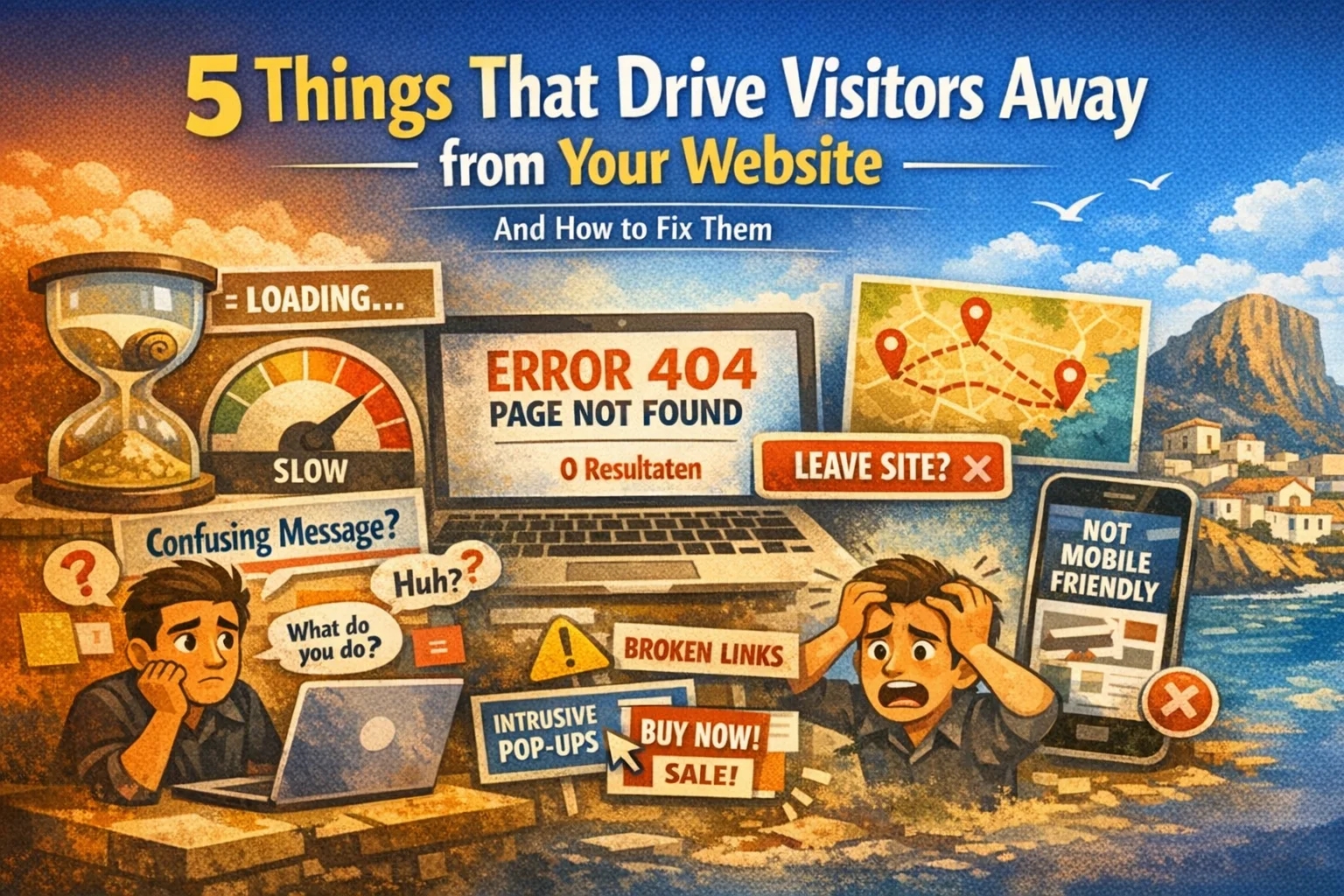

You put time and money into your website. People visit it. And then they leave without doing anything. Here are the 5 most common reasons that happens, and what to fix first.
5 things that drive visitors away from your website (and how to fix them)
You put time and money into your website. People visit it. And then they leave without doing anything.
No call. No email. No booking.
The frustrating part is that it often has nothing to do with the quality of what you actually do. The work is good. The clients who do reach you are happy. But the website is quietly pushing people away before they ever get there.
These are the 5 most common reasons that happens on the Costa Blanca.
1. The page takes too long to load
This one affects everything else. If your page doesn't load quickly, visitors never see your content, your photos, or your services.
Most people abandon a website after 3 seconds. On a phone, with a regular mobile connection, they're even less patient. And on the Costa Blanca, where a large part of your audience is browsing on their phone while sitting at a café in Altea or looking at listings from an apartment in Calpe, slow loading is a real problem.
Common causes: images that were never compressed, cheap shared hosting, WordPress running 20 or 30 plugins at the same time.
Test your own site for free at pagespeed.web.dev. Use incognito mode and try it a few times at different times of day. A score below 50 on mobile is worth taking seriously. The results page tells you exactly what's slowing things down.
2. It's not clear what you do within 5 seconds
A visitor arrives on your homepage. In the first few seconds they're asking themselves one thing: is this relevant to me?
If the answer isn't immediately obvious, they leave.
Many websites on the Costa Blanca open with something vague. A large background photo. A slogan about quality or partnership. And no clear explanation of what the business actually does.
"Web design for businesses in Altea, Calpe and Jávea" tells a visitor exactly where they are. "Digital solutions for modern businesses" tells them nothing.
If someone can't understand within 5 seconds what you do, where you do it, and whether it's relevant to them, you've lost them. And they're not coming back.
3. There's no obvious next step
Most websites have contact information somewhere. Very few make it easy enough to use.
A visitor who's interested in what you offer still needs to know what to do next. If that means hunting through a menu, loading a contact page, and filling in a form, a significant number won't bother. They'll close the tab and call the next result.
A phone number and WhatsApp link visible in the header on every page removes that friction. A button that says "Send a WhatsApp message" or "Request a quote" directly on the page where the visitor is interested does the same thing.
On the Costa Blanca, WhatsApp is how a lot of first contact actually happens. A link that opens a WhatsApp conversation with a pre-written message is worth more than a contact form.
4. The mobile experience is broken
More than half of all web traffic is mobile. On the Costa Blanca, the expat community browses on phones more than you'd expect: checking listings, looking for services, reading about local businesses during downtime.
A site that works fine on a desktop and breaks on a phone loses those visitors immediately. Text too small to read without zooming. Buttons placed so close together they're impossible to tap accurately. Images wider than the screen. Menus that don't open properly.
Test on a real phone. Not a desktop browser with a narrowed window. Actually use it with your thumb, the way your clients do, on a real mobile connection rather than WiFi. Every page. Every button.
5. Nothing signals that the business is real and trustworthy
A visitor who doesn't know you has no reason yet to trust you. And they're not going to contact a business they don't trust, no matter how good the service description reads.
Trust signals are specific things: client testimonials with real names and locations, Google reviews linked from the site, a photo of you or your team, a full address, a phone number (not just a contact form). Each one reduces the sense of risk a visitor feels.
On the Costa Blanca this is especially important. A lot of potential clients are international. They can't easily verify who they're dealing with through local reputation or word of mouth the way a local might. What they see on your website is often all they have to go on.
If there's nothing on your site that says "real people have worked with this business and it went well," most of them will find someone whose site does say that.
These 5 things are fixable. Some take an afternoon. Some need proper technical work. But knowing which ones are affecting your site is the first step.
If you want to know which of these is pushing visitors away from your specific site, send me your URL on WhatsApp and I'll tell you what I find.
Read more: