Speed, design and trust: what makes a website work on the Costa Blanca
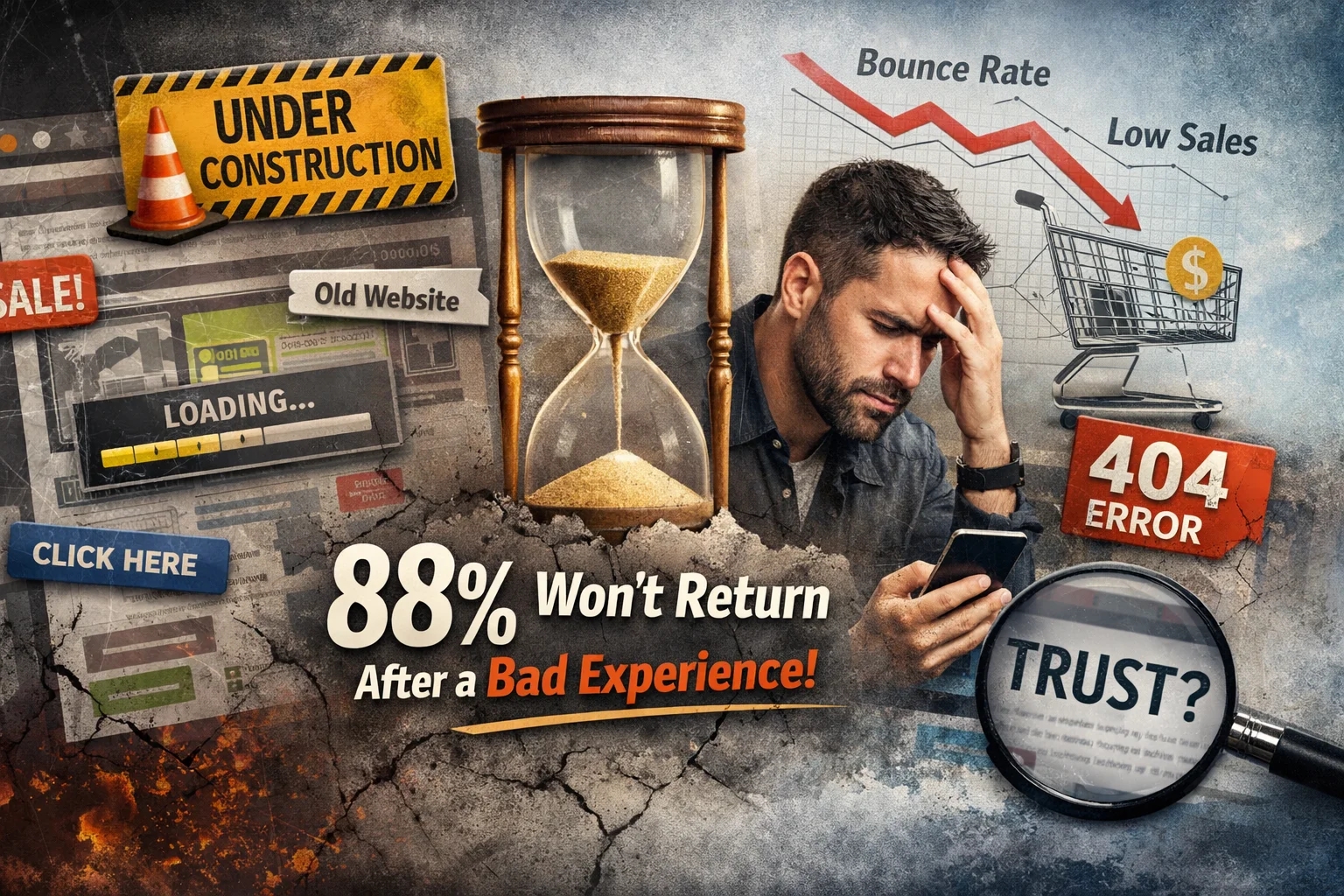

Most websites lose visitors in the first few seconds. Speed, design and trust signals each do a different job. When one fails, the others can't compensate. Here's what that looks like in practice.
Speed, design and trust: what makes a website work on the Costa Blanca
Think about the last time you clicked a link and the page took too long to load. You didn't wait. You clicked back and tried the next result.
Your potential clients do exactly the same thing. Every day. On your website.
Speed, design and trust aren't 3 separate things to get right. They're 3 parts of one first impression, and that impression forms faster than most people realise. Research published in Behaviour & Information Technology found that people form a visual opinion of a website in as little as 50 milliseconds. Before they read anything. Before they understand what the business does.
That's the window.
Speed: the thing visitors notice first
A slow page doesn't just frustrate visitors. It signals something is wrong before they've seen anything else.
On the Costa Blanca, a lot of sites run on cheap shared hosting with uncompressed images and WordPress installations carrying 20 or 30 plugins. The result is a site that takes 5, 6, sometimes 8 seconds to load on mobile. By that point, most visitors are already gone.
Google factors page speed into rankings. Slow sites rank lower and lose visitors at the same time. The impact doubles.
The fix isn't complicated but it does require the right foundation. Fast hosting. Compressed images. Clean code. A technology like Next.js that doesn't carry the weight of a plugin-heavy WordPress installation. These aren't optional extras. They're what a working website is built on.
Design: the thing visitors react to without realising
Once the page loads, design takes over.
Good design isn't about looking impressive. It's about being immediately clear. Does the visitor know within 3 seconds what this business does and who it's for? Is the most important information easy to find? Does the visual hierarchy guide the eye toward the right next step?
Bad design creates friction. A cluttered layout, text that's hard to read, a call to action that's buried below the fold, images that dominate the page without adding meaning. Each of those is a small reason to leave. Together they make the experience feel like work.
On the Costa Blanca, where your visitors often come from the Netherlands, the UK, or Germany and are judging a business they can't easily verify in person, design carries extra weight. A professional, clean, well-organised site tells them something important before they've read a word: whoever built this takes their work seriously.
Trust: the thing that makes them actually contact you
Speed gets them there. Design keeps them reading. Trust is what makes them pick up the phone.
Trust signals are specific things: client testimonials, Google reviews, a recognisable photo of you or your team, a clear address and phone number, case studies showing real results. Each one reduces the risk a visitor feels about reaching out to a business they don't know.
This matters more on the Costa Blanca than in most markets. A Dutch buyer considering a property purchase, a Belgian family looking for a reliable contractor, a British retiree trying to find a trustworthy lawyer: all of them are making significant decisions at a distance, in a country where they don't always know who to ask. Your website is often the only evidence they have.
A site with no testimonials, no photos, no verifiable details, asks them to take that risk blind. Most won't.
Why all 3 have to work together
A fast site with poor design still loses visitors at step 2. A well-designed site with no trust signals gets visitors to read but not to act. A trustworthy-looking site that loads in 8 seconds loses visitors before they see any of it.
The 3 work together or they don't work at all.
If you want to know how your site currently performs on all 3, send me your URL on WhatsApp and I'll give you a direct assessment.
Read more: